

Where Plunder Became Capital
To the casual observer in 1680, Thames Street was a chaos of salt and sweat. To the Crown, it was the most valuable 500 yards of real estate in the Western Hemisphere. To the Maritimers, it was a conveyor belt—a street engineered not for trade, but for transformation.
While the taverns of the interior gave Port Royal its "wicked" reputation, this single stretch of brick-paved waterfront was the city's actual engine. Here, the raw, violent spoils of the Spanish Main were distilled into the legitimate capital of an empire.
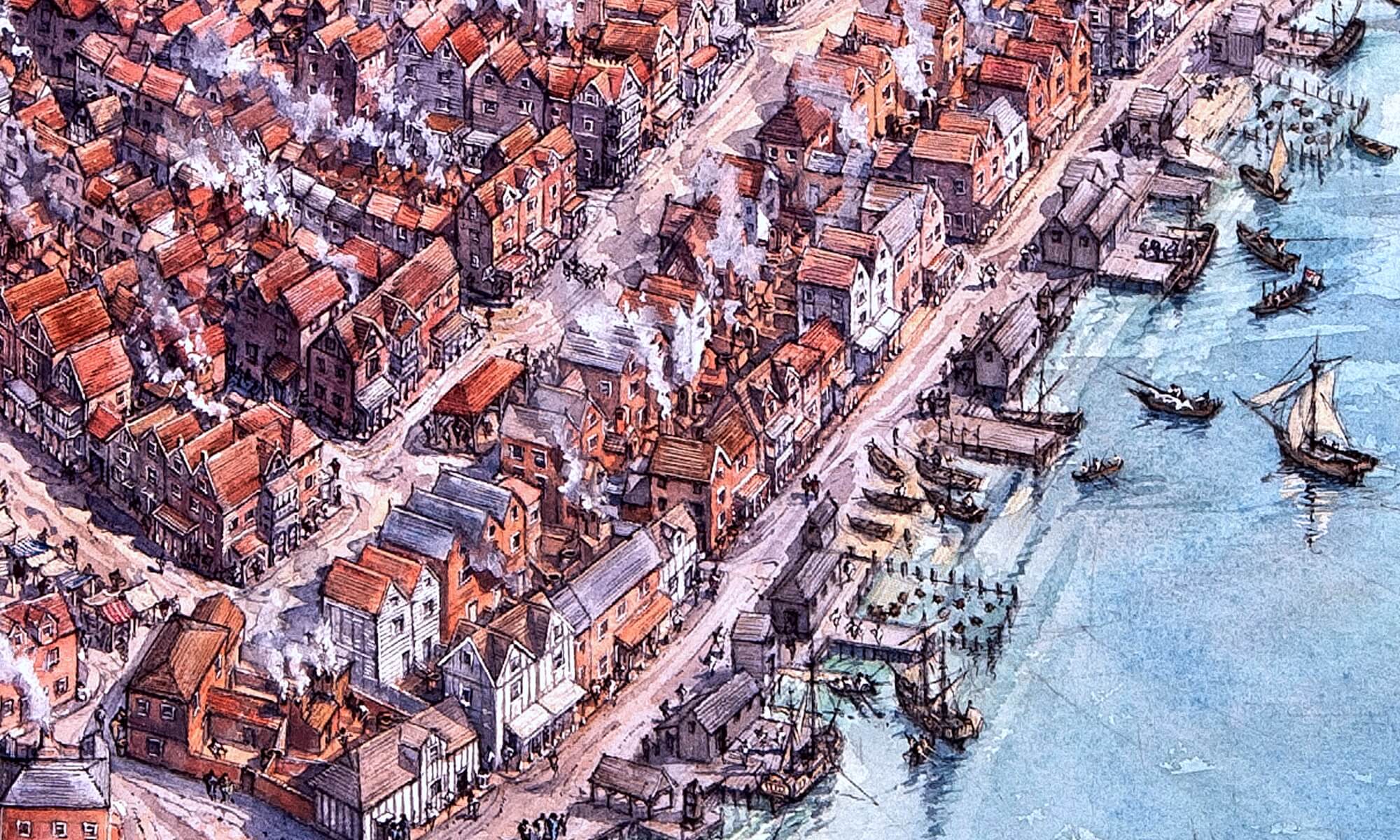
Reconstruction of the Waterfront Merchant Row.
To understand Thames Street, one must look at the northern harbor side of the Port Royal peninsula. While Fort Charles stood as the military guardian at the southern point, Thames Street ran for 500 yards along the protected, deep-water harbor. It was the city's longest thoroughfare, built so close to the shoreline that the sea literally met the doorsteps of the merchant houses.
The architecture was deliberate. Every merchant complex on Thames Street was a three-story machine: a fortified warehouse on the ground, a counting house for intelligence on the second, and a residence on the third. Behind them sat private wharves, allowing prize ships to dock directly at a merchant's back door—bypassing the public King's Wharf and the watchful eyes of official customs.
Archaeological evidence from Building 5 reveals the presence of heavy-duty hearths and lead weights—tools not for domestic life, but for the industrial-scale weighing, melting, and re-casting of precious metals. This physical infrastructure allowed for the immediate conversion of Spanish bullion into "neutral" silver bars, stripped of their origin before the cargo even left the building.
Moses Cardoso · Isaac de Lucena · Benjamin d'Acosta.
These weren't just names in a census; they were the venture capitalists of the 1680s, providing the powder, shot, and credit that kept the privateers at sea. Their homes were the nodes of an intelligence-sharing network that outpaced the Spanish Navy.
A ship arrives from the Spanish Main and docks at a private Thames Street wharf. Merchant credit has already funded the voyage; the cargo—often high-grade cocoa or indigo—is offloaded directly into "dark" storage.
Inside the warehouse, the "cleansing" begins. Spanish markings are stripped from hides. Goods are re-packed into English barrels. Dutch-made ledgers and wax seals found in the silt prove the administrative nature of this transition.
Using Letters of Denization, the merchant swears the goods are Jamaican produce. Plunder is now a legal English commodity, ready for the London markets and fully integrated into the global economy.
The "substance" of Thames Street is confirmed by what the earthquake froze in time. Excavations of these submerged northern wharves have recovered Venetian glass bowls, Chinese export porcelain, and German stoneware. These were not the possessions of crude rogues; they were the curated luxuries of an elite merchant class who used this street to command a network that spanned from Port Royal to the markets of the Far East.
It is this concentration of liquidated wealth and global trade that gave rise to Port Royal's reputation as the "Richest City in the World." By 1692, the probate inventories of Thames Street residents revealed a degree of prosperity that rivaled the finest districts of London and Boston, fueled by a currency of silver coins rather than commodity exchange.
What began as a localized system of transformation on Thames Street didn't stay there. It evolved into a sophisticated international intelligence network—a predecessor to the global financial centers we know today.
To understand how this merchant "spine" connected Port Royal to the counting houses of Amsterdam and the Silver Train of Panama, you must follow the trail into The Forgotten Chapters.